
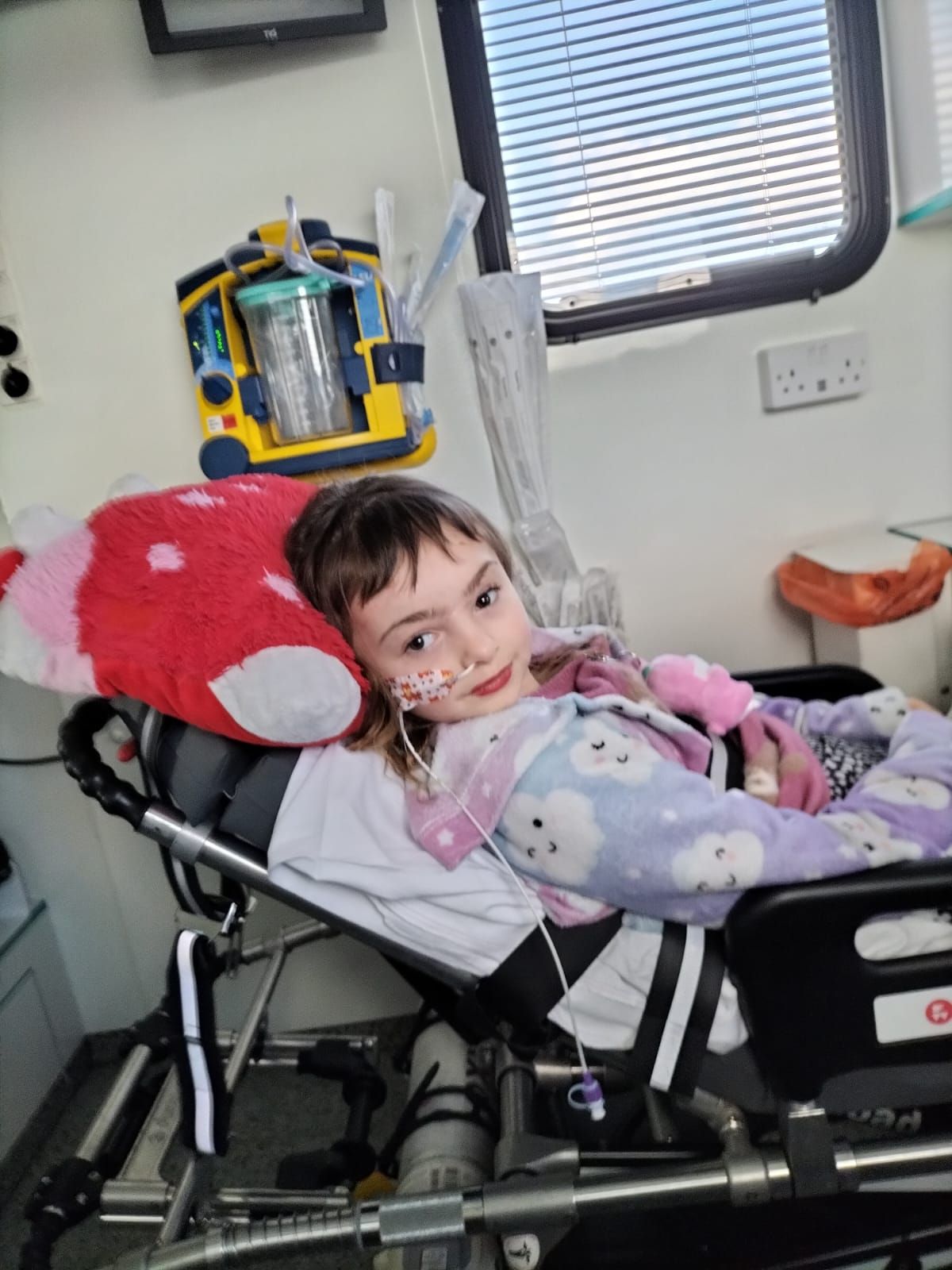
A mum who would have lost her daughter if nearby firefighters had not raced to the scene is horrified at plans to close eight fire stations in Dorset and Wiltshire.
Carla Lambert’s daughter Lila-Claire was six when the family were involved in a crash on the A37 on October 29, 2022.
Crew from Maiden Newton Fire Station – one of the eight marked for closure due to budget cuts – raced to the A37, cut Lila-Claire from the car and started managing her airway.
They also cut down hedges so the air ambulance could land safely.
Had it not been for their swift response, says Carla, her little girl would have died.
She said: “Because of them she survived. I really do owe those brave men everything.
“They were first on the scene – they got her out of the car and resuscitation was able to commence. If they hadn’t been in Maiden Newton Lila wouldn’t be here, absolutely without a doubt.
“She was horrifically poorly – as soon as she got to hospital in the air ambulance she had to have her forehead removed because of the pressure on her brain.
“Another ten minutes and she would have died for sure.
“We still have consequences, but not the consequences we could have had. She’s now walking, talking and living her best life.
“My memory of it isn’t the best – it was terribly traumatic. I managed to get my son Charlie out – he was five at the time and passers by kept him safe. Their dad Tom broke his knee badly.
“For sure, without the fire crew at Maiden Newton Lila wouldn’t be here any more.”
 THAT’S MY GIRL: Mum Carla Lambert with Lila-Claire in Southampton Hospital after the accident on the A37
“When we got to Southampton Hospital there was another child there who had broken her neck in a crash on the A37. It’s a very, very busy road with a lot of accidents and having fire crew nearby is essential – they must be absolutely out of their minds to consider closing the station.”
The first ambulance officer on the scene was Tim Cross, who said: “Lila had sustained a serious head injury in the collision, which damaged her brain and she had sustained several other injuries. The care she was receiving on my arrival was exemplary.
“The Maiden Newton fire crew were working together to manage her airway at a standard I would expect of an experienced ambulance crew.
“Lila’s survival and recovery was nothing short of miraculous and a testament to the work of the air ambulance crew and the surgical, paediatric intensive care and rehabilitation teams at Southampton hospital.
“However, none of their amazing work would have been possible if it weren’t for the work of the team at Maiden Newton fire station, who were just minutes away.
“Their ability to provide early, high-quality basic airway management so soon after the collision undoubtedly saved her life.”

The news that Dorset and Wiltshire Fire Authority is proposing to close the village station, along with Charmouth and six others, has come as a huge blow to the communities they serve, as well as more than 70 firefighters who could lose their jobs – and the union claims 96 posts could be at risk.
With savings as little as £144k per year to close Maiden Newton and £204k a year for Charmouth, surely incidents such as Lila-Claire’s accident would give fire chiefs pause?
Papers on the proposals quote various facts and figures, including that Maiden Newton is only available less than a third of the time due to recruitment issues.
They say low numbers of incidents could justify the closures.
MY HEROES: Lila-Claire and fire station crew, left to right: Jake Chislett, Andy Elliott, Jon James and Ross O’Donovan.
However the West Dorset Magazine understands the station currently offers 59% availability, and has kept many of its staff for years. Their numbers have been growing over the past five years to a point that they now have seven crew, with two more in the process of being recruited.
The fire authority papers say Charmouth “has ten on-call firefighters who provide 95.01% availability and typically respond to a low number of incidents (55 average per year)”.
Maiden Newton, it says, “has seven on-call firefighters who provide 30.95% availability and typically respond to a low number of incidents (30 average per year).”
Cuts ‘not the answer’ says fire union chairman

Fire and Rescue Services Association (FRSA) branch chairman Andy Elliott said: “We are very keen to work with DWFRS to find sustainable alternatives to closing stations. We recognise the difficult financial position that DWFRS is in, but closing 16% of their fire stations is not the answer.”
The Fire Brigades Union has launched a petition at fbu.write.mp/campaigns/cuts-kill-dorset-wiltshire
It says: “Rural communities will be hit hardest. With local stations closed and fire engines removed, residents will be forced to rely on crews travelling from further away.
“Response times will slow. Dorset and Wiltshire is already nearly two minutes slower than the national average in arriving to life- and property-threatening fires. Fewer firefighters and fewer fire engines mean less capacity to respond when multiple emergencies happen at once.”
They added: “Dorset and Wiltshire Fire and Rescue Service is already stretched to breaking point. Since 2010, the service has lost a fifth of its firefighters – and cutting another 96 posts would strip away another 16% of the frontline workforce.
“The consequences of under-resourcing are already being felt. In August 2025, a major wildfire at Holt Heath brought the service to its knees. With too few crews and resources available locally, reinforcements from 17 other fire and rescue services had to be drafted in from as far away as Merseyside.
“As climate change drives more frequent and more severe wildfires, floods, and extreme weather events, the demand on the service is only increasing. Reducing frontline capacity now will make it harder to respond quickly and effectively, putting lives, homes and entire communities at risk.
“Management is trying to make financial savings, but cuts to frontline resources are not savings at all. They come at the expense of public safety.”
Deeply flawed review ‘is the most significant attack in living memory’

The chief executive of the Fire and Rescue Service Association (FRSA) Tristan Ashby has said the statistics in the papers are flawed, and skewed in favour of the closures.
He slammed the plans as “appalling” and accused the authority of giving the union just a week to consider their responses.
He said: “This is undoubtedly the most significant attack on firefighters in living memory and comes at a time when services are fully stretched as a result of wildfires and previous cuts.”
He added: “The scale of these proposed changes will devastate fire cover in Dorset and Wiltshire. As recently as last summer, the service called upon 17 services to assist them in dealing with wildfires as they were unable to cope.
“These proposals will further weaken the service, and there will come a time when there is no one to come to their aid.
“The paucity of data provided is appalling, and we have very significant concerns about how the information and the conclusions are drawn. It is clear to us that a selective narrative has been used to suit a desired outcome… the then Chief Fire Officer selected eight stations he wished to close and built a bogus and partial review to support this.
“The review is wholly inadequate and the worst we have ever witnessed in 50 years of our existence. The current Chief Fire Officer has for some reason known only to himself, decided to continue with his predecessor’s policy.
“What is equally as appalling is the cavalier way in which such major changes to the livelihoods of hard working and dedicated on-call firefighters have been handled, trashing their career prospects and the time and effort taken in obtaining their skills.
“Senior managers have not had the courtesy to seek firefighters’ views prior to issuing their proposals to fire authority members. “Although the Chief Fire Officer says that no decisions have yet been taken, the way in which this whole process has been taken forward clearly indicates that they wish to press ahead regardless, with the assistance of complacent and compliant fire authority members.
“We have not seen any evidence that the service has exhausted all the savings that are possible before sacking firefighters and closing stations – in fact the authority has neglected its legal responsibility as an employer and citizen protector by leaving key decisions in the hands of the Chief Fire Officer. The authority should have asked to review all possible other savings in detail before launching into a ‘slash and burn’ process resulting in closures and sackings.
“We do not believe that the incident data is current or correct, and the authority has made no assessment regarding the impact of the proposed changes on the area’s well recorded sensitivity to wildfires and flooding. How it will deal with surge events with even fewer firefighters and appliances is not even considered. This review is deeply flawed.”
One firefighter, who did not want to be named in case of repercussions, said: “According to national statistics, we are already failing to meet our response standard of 10 minutes.
“According to the latest Government stats, the average response time for DWFRS as of Sept 2025 was 11m 24s. A failure of nearly 1.5 minutes and DWFRS have been failing since 2020/21 and getting progressively worse.
“The data released by DWFRS yesterday suggests that the response times in the Maiden Newton area will be further degraded by another four minutes and 49 seconds.
“That means that DWFRS Response Standard of 10 minutes for a sleeping risk will, in fact, be 16 minutes and 13 seconds for Maiden Newton if they close the Fire Station. This is not safe, it will lead to loss of life and property.”
Differences in the data
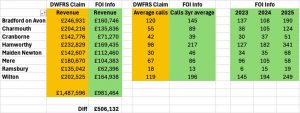 This table shows the difference between the data published by DWFRS in the supporting documentation for the proposal to close the stations and the data that the FRSA received from DWFRS via a Freedom of Information Request.
There is a substantial difference in the cost saving. The fire service appears to have added 50% to its projected savings.
In the papers to go to committee, the service claims it will save £1,487,596 by closing the stations, yet in its response to the Freedom of Information request it seems as if only £981,464 would be saved.
DWFRS Assistant Chief Officer Jill McCrae, pictured inset, said: “Availability of on-call fire engines across the service is affected by a large number of factors and we don’t underestimate the commitment and sacrifices our on-call staff make to ensure their fire engine is available to respond to emergencies.
“As a result of this, availability is a lower weighted factor in the data produced for the potential station closure project.
“The reports presented to our Fire & Rescue Authority look at the most recent complete year (2024-25). The average availability for Maiden Newton over that year was 30.95%. We have used the most recent complete year following feedback from our crews and staff on previous projects.
“The consultation leaflet gives an average over five years (2019-2024). During this period, Maiden Newton’s fire engine was available, on average, for 31.22% of the time.”