
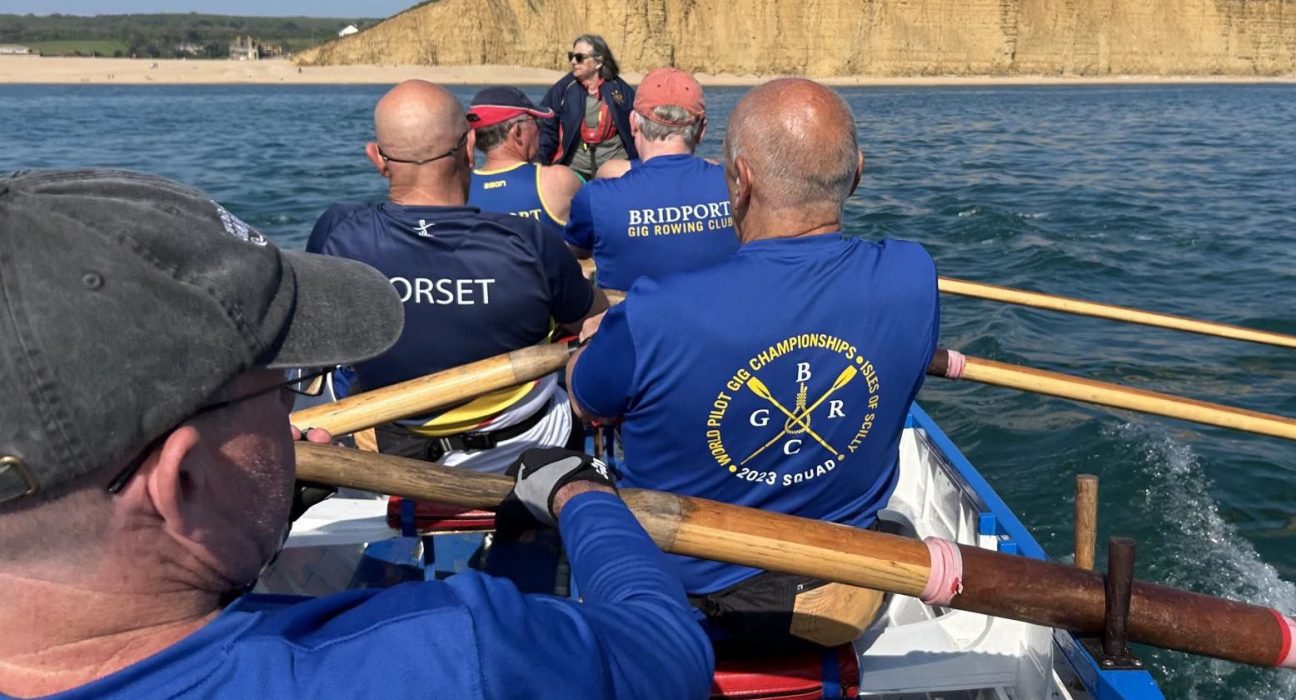
Six rowers are in a traditional Cornish pilot gig, pulling hard in practiced unison, and Dagger skims across Lyme Bay like she’s grown wings.
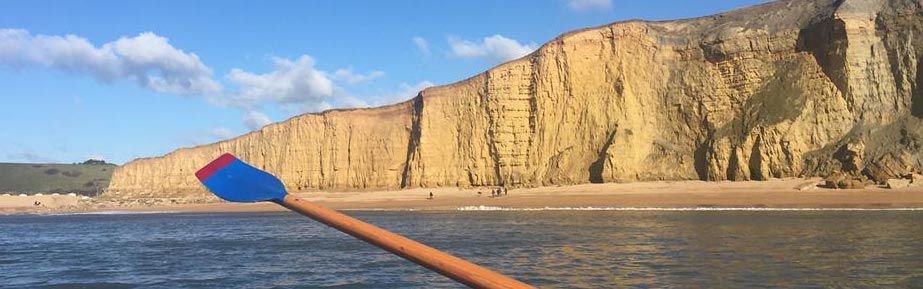
From the pilot seat, there’s a breath-taking view of sunlight dancing on waves as they roll in towards the cliffs rising at West Bay and Burton Bradstock.
Dolphins, seals, barrel jellyfish and even the odd peregrine falcon are not unusual travelling companions for Bridport Gig Rowing Club.
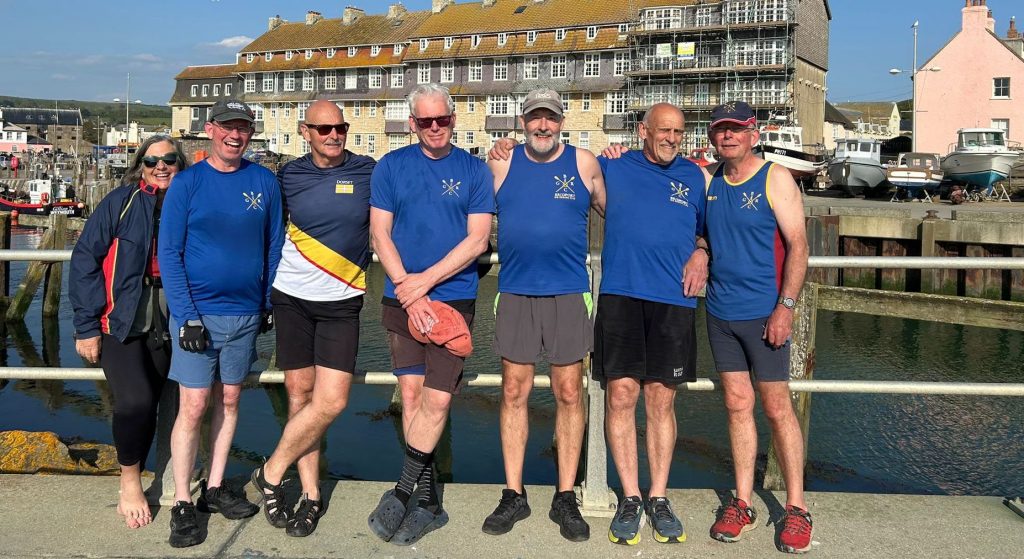
I’m out with members of the B and Open Masters crews. They’ve trained all winter, four times a week, braving rain and ice in the harbour at minus seven degrees, even raced in two-metre swells.
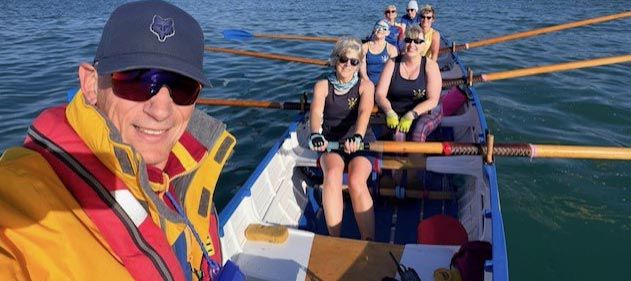
I joined them on their last row before heading to the World Pilot Gig Championships on the Isles of Scilly, with several other crews from Bridport.
And all their hard work paid off – the Women’s A crew came 18th overall to stay at the top of the Jurassic league, and the men’s Masters beat last year’s performance, finishing in 12th place.
Their camaraderie is evident, from gentle ribbing on the sea to a cheerful debrief at the pub. And it goes deeper. The crews act as a community lifeline, supporting each other through life’s ups and downs.
As one rower points out, healthy life expectancy in the UK is dropping and now sits at just under 61 years, according to The Health Foundation.
But the people in this boat are bucking the trend, with all but one of them retired, and showing no signs of stopping.
They are all enthusiastic about the benefits of gig rowing, describing it as fun, invigorating, low impact exercise.
Colin Savill, 64, says: “We’re very fortunate because we’ve got the time and opportunity to do this. It is a really good structure if you’re retired. It’s a fantastic thing to do.”
Simon Crafter, 62, adds: “Who wouldn’t want to be out to see all this? It’s fitness and wellbeing. It’s wonderful.
“And racing is fun, there’s lots of other local clubs and people to race against and socialise with.”
Sue Skillern, 65, is their cox and jokes that shouting at six men comes quite naturally to her.
It takes a year to qualify as a cox, and there’s a lot to learn.
But the dynamic on the water is clear and non-negotiable: the cox has everyone’s life in their hands, and so the crew does exactly what she says.
No arguments. New members are told this from day one.
Sue describes herself as the seventh person in the crew – not above it, just part of it. Everyone in it together.
She talks about how hard they work, what it costs some of them just to show up.
“They need to keep going,” she says. “And that’s how we all feel. I do it for them and they do it for me.
“We have this beautiful place to be, and we’re in that very small bracket of people our age who still keep fit.
“We’re friends – we go for a drink afterwards, we meet up, we look out for each other. “It works for our mental health as well as everything else.
“And then there’s this strange thing that happens when you start rowing: you become competitive against yourself. You want to get it right. Every day the sea is different, and every day there’s a new challenge.”
Bridport Gig Rowing Club has more than 100 members and draws people from as far away as Crewkerne and Yeovil.
This surprised me – but having been handed an oar, I found the rhythm, felt the pull of the tide, and understood immediately why people drive for miles to do this, three or four times a week.
There is such a simple beauty and relief of being out on the water, feeling free, feeling at peace.
I was terrified of ‘catching a crab’ – rowing lingo for losing control of the oar – but managed to keep my end up to a decent standard for a newbie. Or so they reassured me!
The club has five boats in total: four traditional wooden racing gigs – Brydian, Blaez, Dagger and Beacon – and one training boat, Buckydoo. As the gigs cost £35,000 each, the club is always raising funds and on the lookout for new members.
It costs £45 for the training course and £95 to join for a year, or £70 for over-60s and those on benefits. Sessions are £3 a time. There is also a welfare fund to help people who need financial support. The club is trying to attract younger rowers too – under-16s especially.
Julie Savill, who organises Learn to Row courses, says: “It’s an amazing way to get kids out of the house, active, away from screens and meeting other people of their own age.
“We’ve got a real mix of people coming through.
“The one thing that we hear time and time again is that for people who are new to the area and people who are newly retired, this is a really good way to stay active and make really good social connections.”
The Scillies championship kicks off the competitive season, which runs through to September and takes in regattas across the southwest, including one hosted by Bridport.
Not everyone comes for the racing. General rowers – people who want the water, the scenery, once a week or once a month, whatever fits – are just as much a part of the club as the squad.
And I can vouch from my own experience that they will be made to feel very welcome.
Julie adds: “If you want to connect with the community, enjoy beautiful sea and scenery, and a way to maintain or improve your fitness, we would love to have you on board.”