
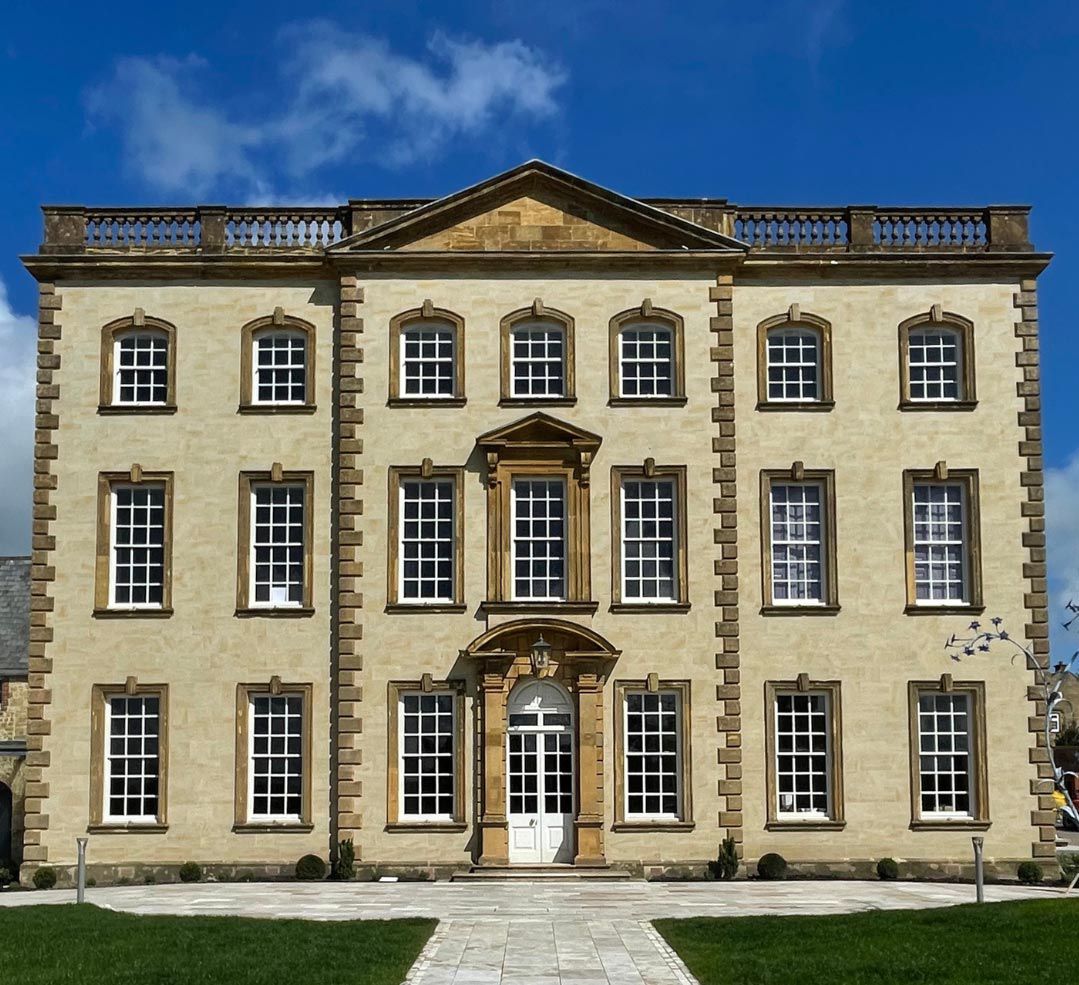
In Sherborne, two buildings stand as testament to what happens when history is lovingly conserved – and when it isn’t.
The fortunes of The Sherborne – formerly Sherborne House – and Newell House could not be more different, yet their histories are so entwined.
Both former schools, with fond memories for former pupils, one now stands as a shining light of the arts and a wonderful resource for the community, following a £15 million restoration and extension. The other lies in ruins after a fire in April.
Here, MIRANDA ROBERTSON visits the awe-inspiring The Sherborne, which was pulled from dereliction to grandeur and reopened as a premier arts venue and community space in 2024.
It seems unthinkable now, but when hospitality magnate Michael Cannon offered up the funds to buy Sherborne House in 2018 it was a wreck – and listed on the English Heritage Buildings at Risk register.
A fine example of early 18th century architecture, it is home to one of only three surviving murals by the celebrated artist and history painter to George I, Sir James Thornhill. Of the other two, one is in the dome of St Paul’s Cathedral and the other is in the Painted Hall at the Royal Hospital in Greenwich.
Despite having such distinguished artwork, Sherborne House was inexplicably left to rot after the grammar school housed there closed and a subsequent charitable trust struggled to maintain it as an arts venue.
Michael left comprehensive school aged 15 having struggled with dyslexia, and travelled the world by boat before making his fortune in the pub trade. He bought Dorchester brewery Eldridge Pope in 2005.
A great philanthropist and arts lover, he envisaged a new future for Sherborne House. With Thornhill’s striking mural of a Caledonian Boar Hunt depicting the goddess Diana filling the stairway, it had art at its heart, and Michael envisaged the house as a mecca for the arts, open freely to all.
The Baroque mural was painted in the 1720s, just after the house was built. Girls attending Lord Digby’s School for Girls there in the 20th century would have to line up to see the headmistress on those stairs, forbidden to touch the walls or even pass each other on the stairs lest they touched it.
The school closed in 1992 and it was reopened as a visual arts venue under Sherborne House Trust a few years later. The original trust had great plans for the house – much research was carried out into its history and lottery grants were applied for to restore it. However maintenance costs were simply too high and in 2008 Dorset Council sold the house to a developer.
The firm built 44 homes on one section of the land, then sold the house on, untouched, to a new Sherborne House Trust (2018), funded by Michael Cannon. Sadly Michael died aged 84, before The Sherborne opened.
Hooray Henry who bought Sherborne House for £1,155
Sherborne House was built in the early 1700s by Benjamin Bastard of Blandford, for ex-soldier and MP Henry Seymour Portman. The house replaced an older building, which Henry had purchased for £1,155.
Henry had become wealthy through marrying an heiress and a large inheritance and wanted a halfway house between his other properties in London and Somerset.
By the time he commissioned Sherborne House he was married for a second time – this time to a teenage bride, despite Henry himself being in his late 70s or early 80s. Henry died in 1728, before the glorious mural he had commissioned in the hallway was finished.
The house passed to a nephew, then was bought by the second Earl Digby in 1816. For years, right up until it became a school in 1931, it was rented out.
For nine years it was occupied by the famous actor William Macready, who was great friends with Charles Dickens, who came to the house and read A Christmas Carol to guests. Browning and Thackeray also made appearances. Macready left in 1860 having suffered the deaths of three of his children, his wife and his sister under that roof.
The restoration of The Sherborne was a painstaking affair. Dorset-based SPASE design – the architects behind projects at Athelhampton House and Duntish Mill Farm – worked to create a new space in the old frame, preserving some incredible features while adding a gorgeous, airy extension with a copper roof, with a flat living roof connecting new and old.
That extension houses the restaurant, where people can enjoy light lunches and evening meals surrounded by the artwork of The Sherborne’s current exhibitions.
Outside, the gardens were remodelled and spaces made for art pieces such as the wonderful allium sculptures at the front, and changing sculptures at the back.
- To get to The Sherborne: head to Newland, DT9 3JG. Open 10am-5pm Mon-Sat, 10am-4pm Sun. Restaurant now open evenings, Weds-Sat.