
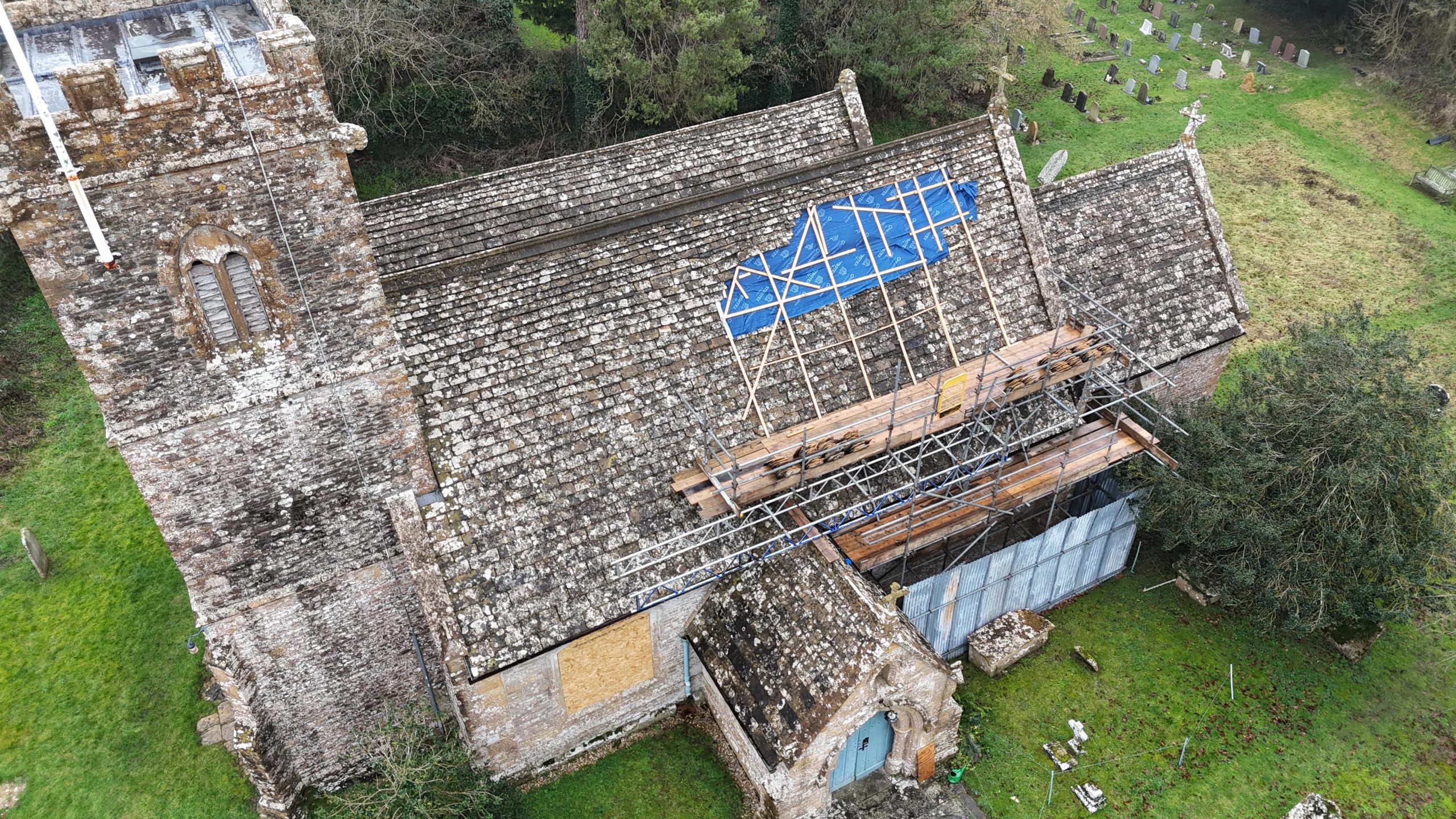
By MARY CLEGG, Churchwarden: Tucked away in the timeless landscape of the Halstock Vale stands St Juthware Church, a small rural church with a story that stretches back to the fifth century – and a very present-day crisis in its roof.
Today, rainwater is finding its way through a huge hole in the roof, threatening the fabric of this historic building. Local parishioners are launching fundraising efforts to finance major repairs, hoping that by telling the church’s remarkable story, they can rally support from the wider community.
Who was St Juthware?
The church is named after St Juthware, a headless saint recorded to have lived in the fifth century. According to tradition, Juthware was venerated for her generosity: she gave alms to the poor and to pilgrims, who passed along a pilgrim’s way that still runs right outside the church today.
Falsely accused by her brother of ‘dishonourable conduct’, Juthware was ultimately beheaded by him – a punishment from resentment of her kindness and charity.
It is this same ancient route, once trodden by medieval pilgrims, that now brings visitors to a place where spiritual history and English landscape meet. The church’s roots in this early Christian devotion give it a significance far beyond its modest size.
The building itself is a tapestry of English history in stone and tile. The church boasts a 15th-century tower, an enduring landmark on the skyline of the vale.

Within that tower hang 16th-century bells, which have marked the passing of centuries of village life – from baptisms and weddings to harvests and memorials.
Perhaps the church’s greatest artistic treasure lies not above but at the east end, in the chancel (or sanctuary). Here, the Minton encaustic tiles are the work of AW Pugin, the noted Victorian architect and designer associated with the Houses of Parliament.
These Pugin-designed tiles bring a direct connection to the high point of 19th-century Gothic Revival design into this quiet rural parish, making them a point of real architectural interest.
St Juthware Church is Grade II listed, recognised nationally for its architectural and historic importance. The surrounding churchyard continues that story.
Several tombs in the churchyard are also Grade II listed, bearing witness to generations who lived and died in the parish.
Among them are war graves, solemn reminders of the local men who served and fell in conflict, tying this remote corner of the countryside to the wider history of the nation.
The village street in which the church stands is lined with many more Grade II listed buildings, some reaching back to the 16th century, creating a remarkably intact historic setting.

What truly sets St Juthware Church apart is not just the building, but the landscape that cradles it. The church overlooks the Halstock Vale, with fantastic views that have barely changed in hundreds of years. The area falls within what was formerly designated an Area of Outstanding Natural Beauty and nearby lies a Site of Special Scientific Interest at Bracketts Coppice.
Within walking distance of the church are lovely farms and woodlands, and the sense of a landscape that has remained largely untouched by modern development is palpable. The harmony between church, village, and countryside is part of what makes this place so special – and so important to preserve.
That is why the huge hole in the roof and the urgent need for major repairs are more than just a local maintenance issue. They are a threat to a complete historic ensemble: a church rooted in early Christian devotion, enhanced by medieval and Victorian craftsmanship, sitting in a landscape that still reflects its ancient past.
In response, the church community is organising a series of fundraising events and is inviting the wider public to come and see what is at stake. St Juthware is honoured with her own feast day on July 12, and this year the parish is planning a three-day festival of flowers, music, and food to celebrate the occasion.
At the heart of these efforts is a garden party, held in an NGS garden (National Garden Scheme). This stunning garden at Norwood House, Corscombe, is being specially opened to support St Juthware Church on Saturday, June 13 at 3pm.
Visitors will be able to enjoy tea and cake served in a traditional village setting with guided tours of the garden and woodland. There will be the chance to take in the panoramic views over the Halstock Vale plus an opportunity to learn about the church’s history, from St Juthware herself to the Pugin tiles, medieval tower, and historic bells.
The aim is not only to raise the funds needed to repair the roof, but also to highlight the church as a place of real cultural and historical interest.
Read more about church bells, stained glass windows and more in our Church news section.