
For hundreds of years, he’s been standing proud, waving his enormous club whilst keeping watch over the sleepy village at his feet.
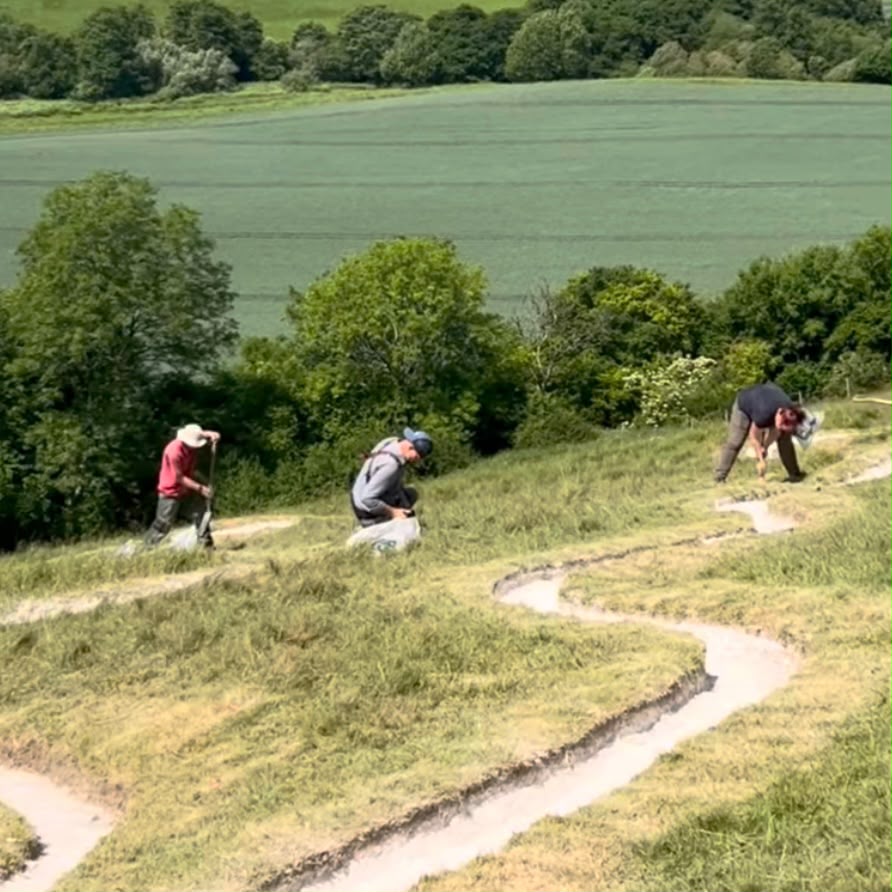
Now, re-chalking of the Cerne Abbas Giant is underway, with National Trust rangers, volunteers and members of the public working together on the steep chalk hillside to restore his distinctive white outline.
The process, which takes place roughly once every decade, involves digging out older chalk and packing in fresh material by hand – a technique that has changed little over centuries.
Around 17 tonnes of chalk is being used for this year’s work, which is expected to take two weeks. The slope, which rises at a gradient of around one in three, means the chalk must be packed tightly to prevent water getting in and weeds taking hold.
Elizabeth Flight, the National Trust’s senior visitor experience officer, said: “We still use a simple process that dates back hundreds of years.
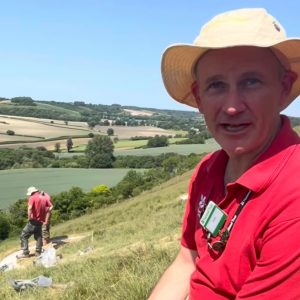
“Our trained volunteers are digging out the lines and cutting out the grass where it’s grown over, to make the lines of the Cerne Abbas Giant more visible, bringing them back to what they were.
“Then they fill the lines in, taking out the old chalk and then replacing it with new chalk.”
Sourcing the right chalk has presented its own challenges. The local quarry that previously supplied material has closed and finding chalk of sufficient quality – bright white and high grade – has become increasingly difficult.
The chalk being used this time has come from a building site in Dorchester, where excavation work uncovered deposits sitting on high chalk geology, which were then cleaned and filtered by an aggregate supplier.
Luke Dawson, lead ranger for the National Trust at West Dorset & Cranborne Chase, explained that recent years have brought new pressures to the site surrounding the Cerne Abbas Giant.
“We’ve noticed algae growth starting to dull the Giant’s bright white outline.
“We can’t say for certain what’s driving that, but warmer, wetter conditions may be a factor and it’s something we’re continuing to investigate.
“We’re also seeing more intense rainfall, which can increase water run-off and gradually wear away the chalk, so we’re planning further monitoring to understand the impacts and how we might need to adapt – potentially by re-chalking more often.
““We will also explore ways to retain more water within the landscape, for example by allowing areas of scrub to develop and establishing permanent grassland.”
The re-chalking follows a national fundraising appeal that raised £330,000 in 60 days, enabling the National Trust to purchase more than 130 hectares of land surrounding the Giant, protecting the wider landscape for nature, archaeology and public access.
The appeal, backed by Sir Stephen Fry, saw donations flooding in from across the UK and as far afield as Australia, Japan and Iceland.
A small number of people who donated were selected through a prize draw to take part in the re-chalking itself.
The fundraising marks the beginning of a bold new chapter for the historic Dorset landscape on which the Cerne Abbas Giant lies – a species-rich chalk grassland, a Site of Special Scientific Interest, and important archaeological landscape.
Home to rare wildlife including the endangered Duke of Burgundy butterfly, the newly protected land offers a once-in-a-lifetime opportunity to create a connected mosaic of habitats, restoring nature and improving access, while working closely with the local community.
When was the Cerne Abbas Giant built?

The Cerne Abbas Giant stands 55 metres (180 feet) tall and is Britain’s largest chalk hill figure. He was given to the National Trust by the Pitt-Rivers family in 1920.
His origins have long puzzled historians, sparking theories ranging from a Roman Hercules to a satirical depiction of Oliver Cromwell.
In 2021, however, National Trust commissioned scientific analysis that transformed understanding of the figure, revealing that the Giant was probably first carved in the late Saxon period, between 700 and 1100 AD.
Luke added: “Because he’s got this giant club in his hand, the main person I’d identify him as being is Hercules.
“Other people say that it could’ve been an abbot that served in Cerne Abbey around the time or a little bit later, and lived possibly in this trendle, which is this earthwork you see on top of the hill.
“So there’s different theories, and different people back different ideas for his actual identity.”

Whatever his origins, the work to protect both the Giant and the landscape around him has struck a chord far beyond Dorset.
“This re-chalking feels especially meaningful,” said Hannah Jefferson, General Manager for the National Trust at West Dorset & Cranborne Chase.
“For centuries, people have cared for the Giant by renewing him in chalk.
“Now, thanks to thousands of people coming together through the appeal, we can care not just for the figure itself, but for the extraordinary landscape that surrounds him.
“As fresh white chalk restores the Giant’s unmistakable outline once more, it’s a powerful reminder that his story is still being written – not just by history, but by the people of today.”
Read more of our Cerne Abbas stories.