
By Viviane Horne
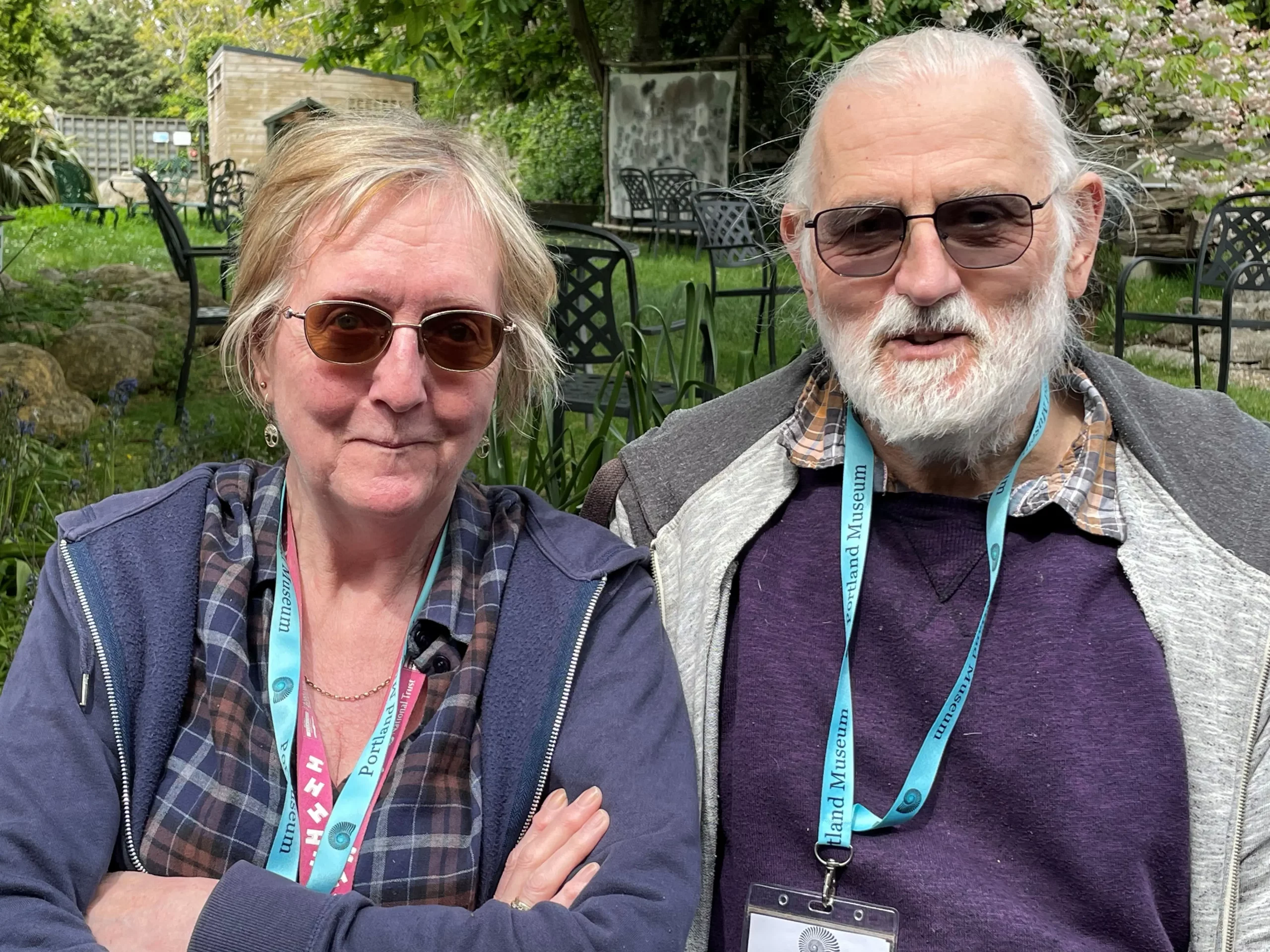
Stella New is one of the friendly faces that greet you at Portland Museum.
Stella lived in Kingston-upon-Hull until she was 18, when she went to Leeds University to study physiotherapy.
Her dad was a GP who sang in the local choir. Sadly she was only 19 when her mum died and 24 when she lost her dad.
She joined the RAF, spending two years in Cosford and two in Weberg, Germany. She married an Australian but they separated due to never seeing each other.
After a term as matron at a boys’ school in Yorkshire she worked as a physiotherapist in York and met husband John in April 1981.
Stella sang at the folk club there and danced with ladies’ Morris team Acorn, John with men’s team Ebor. While in York Stella did A level archaeology at night school.
They moved to Portland in 1986 when Stella was seven months pregnant and daughter Eleanor was 15 months old. Stella was a stay-at-home mum till 1989, when she went back to physiotherapy at Portland hospital.
She danced with Royal Manor Morris Side performing Cotswold, Ilmington, Bampton and Eynsham dances as well as Dorset Stave dancing. Sadly the dance side stopped in 2001 as they could not recruit new members.
She has been in the Quangle Wangle Choir for 25 years.
When Stella retired she got involved in the Church Ope research project and joined her friend Jean at Portland Museum as a volunteer.
She has performed with The Portland Players in The Tempest, Heart of Stone and Caught in the Net, the latter two by local writer Sarah Action.
John New is an expert in ancient railways – the first were recorded in 1604. These two-track systems were used in Cumbria, East Midlands, Severnside, the Black Country and lasted into the 1900s.
John is a Tudor railway expert and has had three papers published, including one on the evolution of the London to Portsmouth line. This year he gave a talk for Portland Museum in the Easton community hall, on Portland’s lost railways.
The first railway in Dorset was Foyles Tramway in the 1790s, running from Swanage to Poole harbour. The second was on Portland.
The Merchant’s railway opened in 1826 from Priory Corner to Castletown. There were also several ‘feeder’ tracks from various quarries to meet this line.
John is now director of the International Early Conference and is editing the papers from their recent conference in Darlington. He got involved at Portland Museum because Stella volunteered there.
John loves the quirkiness and the industrial feel of Portland. He says it has retained more customs because it was cut off before the bridge was built, for example women had more rights on Portland due to these old customs.
Writers in the 1700s noted that a woman could choose a husband and not marry unless pregnancy was confirmed. She could choose another suitor if after a suitable time of courtship there were no positive results!
What’s on at Portland Museum
Dinosaurs, fossils, shipwrecks and smugglers, stone carving, seafaring, ground-breaking scientists and world-famous authors: Portland Museum packs in an astonishing collection that reflects the history and people of this distinctive island community.
Nature Unearthed: Portland Museum’s Summer Archaeology Festival is on from July 29 to 30.
Discover the story of the Earl of Abergavenny and the tragic chain of events that led to its sinking.
Portland Museum’s Portland People Collection reveals something of the nature of the local people whose lives were often based around the skills and knowledge required to work with the sea, the stone, and the soil.
Read more Portland stories:
- Portland Museum invites us to uncover 2,000 years of history with archaeological treasures
- ‘Bonkers’ Portland incinerator set to burn 67 more types of waste
- Heartwarming comeback: Portland farm reopens 4 days a week after cost-of-living closure
- Portland Fair brought back to life as b-side festival reveals 2026 line-up