
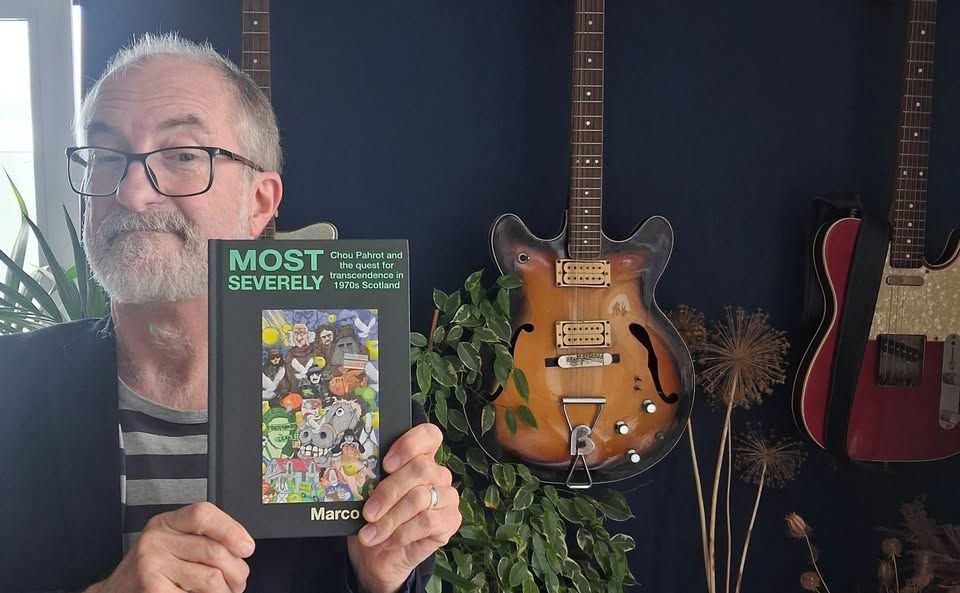
Some bands win you over slowly. Chou Pahrot gave you about 10 seconds to either love them or run for the door, says their biggest fan.
Marco Rossi remembers one performance vividly. Chou Pahrot had stepped in as last-minute support for the Rezillos at the Glasgow Apollo, and as the band tore into the noise coda at the end of one song, a row of punks in front of him plugged their ears.
“Hard Glasgow punks with their fingers in their ears,” he says, still delighted. “That says everything about them.”
Now Marco, a musician and writer who has lived in Dorset since 1981, has written the band’s story. Most Severely: Chou Pahrot and the quest for transcendence in 1970s Scotland is published by Edinburgh imprint Kennedy & Boyd. It is his first book, and it has been a long time coming.
“I’ve been threatening to write it in my own mind for 45 years,” he admits.
Discovering Chou Pahrot
Marco first saw Chou Pahrot in a Greenock pub at 16 and was hooked. The band played pubs across the west of Scotland from 1977, often several nights a week. He stopped counting the gigs he went to at 100.
The band are hard to pin down. Largely instrumental, with a violin as one of the lead instruments, they bellowed their occasional vocals in broad Scots. Their long hair and musical chops led some to dismiss them as late prog. Marco sees them as closer to punk.
“What they were doing was so confrontational,” he explains. “There was nothing polite about it. They could be dead melodic, but some songs were almost an excuse to make as much noise as possible.
“You had 10 seconds to make up your mind whether they were going to be your band for life, or whether to call the police.”
The book’s title comes from the band’s habitual closing number, whose improvised middle section often descended, or rose, into full-blown anarchy.
Marco and his gang from Greenock and Gourock were among the band’s most loyal fans, always right at the front. Curiosity got the better of him. He started asking the band questions and lent them an album by the American band Pere Ubu, sure they would love it.
Friendship followed. Bass player Bob Donaldson became a lifelong friend, and Marco’s first band, Apartment Six, went on to support Chou Pahrot several times.
Those early gigs took him to some strange places. One was an “antisocial disco” in Paisley, where the line-up included a performer known as the poet in the wardrobe. Marco helped carry the wardrobe down a flight of stairs. The poet then climbed inside and recited his work through a microphone, surrounded by flashing lights.
“It was stupid, left-field, avant-garde stuff, and it was delightful,” Marco recalls. “That was my start in music. It’s the thing I’ve been chasing ever since.”
The day Chou Pahrot played for Marco
The push to finally write the book came in 2021, on Marco’s 60th birthday. His wife, Julie, had planned what looked like a lovely trip to Scotland to see family and friends. It turned out to be much more.
First came a surprise party with old friends at a new art gallery in Gourock. The next day, he was led into that same gallery wearing a blindfold. When it came off, Chou Pahrot were there, and they started to play.
“My knees went,” he says. “I couldn’t believe it. That kindness really moved me. I thought, I need to repay them for this somehow.”
Marco, who now lives in Dorchester, interviewed the band before every chapter and asked for their feedback afterwards. He wanted to place the band in context, locally, nationally and internationally.
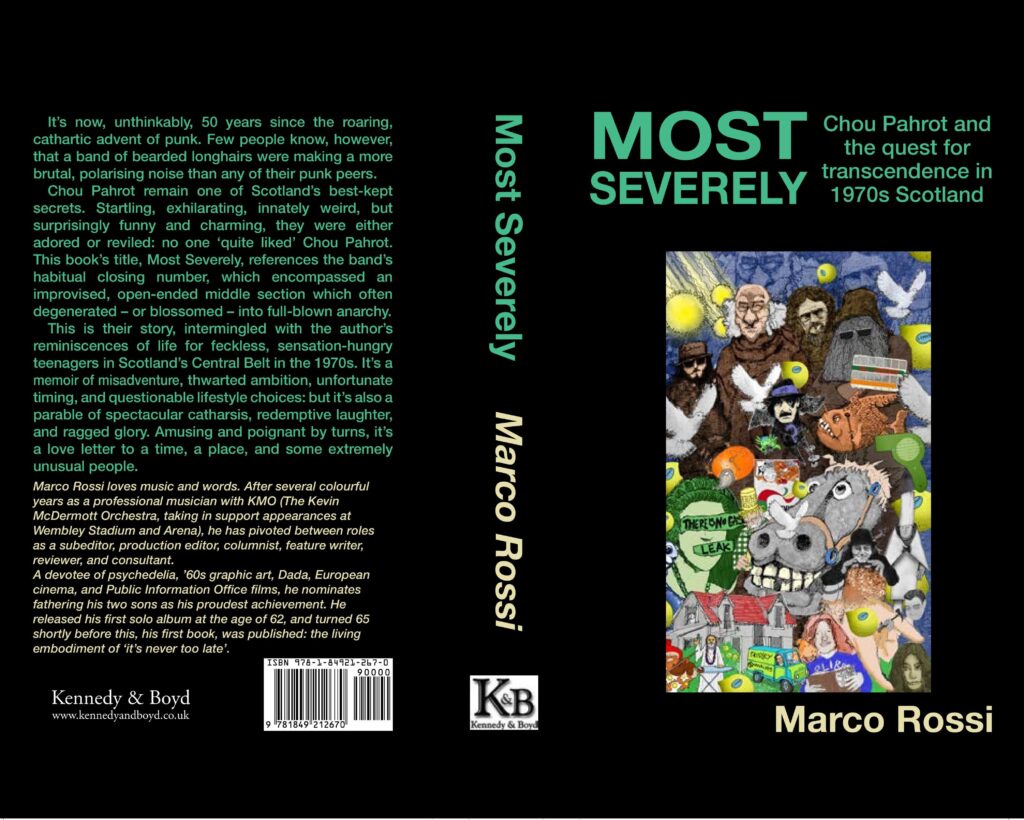
He describes the book as an expansion of the accepted punk story, and a record of a scene that would otherwise vanish. With no internet and little mainstream coverage at the time, few other accounts of Chou Pahrot exist.
It is personal, too. The book weaves in Marco’s own memories of being a feckless teenager in Scotland’s Central Belt.
Marco’s Dorset story began with an advert in the back pages of the NME for places to study at the Dorset Institute of Higher Education. He was accepted and moved south in 1981. Here he made lifelong friends and met his wife, Julie.
He went on to play guitar in KMO, the Kevin McDermott Orchestra, after guitarist for The Pretenders, Robbie McIntosh, recommended him. Marco’s years with KMO earned him cult status and included support slots at Wembley Stadium and Wembley Arena.
He currently plays with Dorset bands such as Jess Upton and the Guilty Pleasures and Gothic Chicken.
His covers album of 60s psychedelic tracks, The Sincerest Form Of Flattery, was released on the Fruits De Mer label.
His ‘beautifully understated’ solo project, Since Returning From The Moon (Last Night From Glasgow), was recorded in his son’s bedroom on a single microphone with Marco performing all components.
Alongside music, Marco has worked as a subeditor, production editor, columnist and reviewer. He writes for Record Collector and Shindig!, has contributed features to Universal’s uDiscover Music website, and has written sleeve notes for reissues on the Rev-Ola and Esoteric labels.
Marco also produced the English translation of Looking Back, Naked – Fred Baggen’s biography of the Dutch progressive band Supersister.
One friend has already compared Most Severely to This Is Memorial Device, David Keenan’s acclaimed novel about a fictional 1980s music scene in Airdrie. “That’s the highest praise,” Marco says. “It doesn’t get better than that for me.”
Where to buy the Chou Pahrot book
Kennedy & Boyd have published the book in hardback and paperback, with the hardback carrying 78 colour illustrations.
Marco launched Most Severely at Waterstones Dorchester on Thursday, October 8.
It’s available in hardback (£45, ISBN 978-1-84921-267-0) and paperback (£20, ISBN 978-1-84921-268-7) from Kennedy & Boyd, and can be ordered through any bookshop.