
People lucky enough to have tickets to marvel at the Bayeux Tapestry at the British Museum will see a Norman knight who held Rampisham in West Dorset.
According to a local antiquarian journal published over a century ago, Wadard of Bayeux was one of the most faithful servants of William the Conqueror’s half-brother, Bishop Odo.
Wadard crossed to England with Duke William of Normandy in 1066. He is one of only a handful of people named on the Bayeux Tapestry, where he appears on horseback during a scene of Norman troops gathering food and supplies after the landing.
This has led historians to suggest he helped organise the army’s provisions, and the prominence of his portrait suggests he was a man of some standing.
The vicar who linked Rampisham to the Bayeux Tapestry
The then Dorset Editor of the Somerset & Dorset Notes & Queries (SDNQ), Richard Grosvenor Bartelot (1868-1947), pointed out that Wadard was the Domesday lord of Rampisham.
Writing in 1922, Bartelot said: “Wadard of Bayeux was one of Bishop Odo’s trustiest retainers, and as such he figures in the Bayeux Tapestry which the Conqueror’s half-brother caused to be made to celebrate the victory of Hastings. To the multitudes assembled in Odo’s Cathedral on those festivals when this pictorial panorama of the Conquest of England was unrolled to public view, the warrior Wadard must have been a popular figure, and for their benefit ‘HIC EST WADARD’ is inscribed above his head.
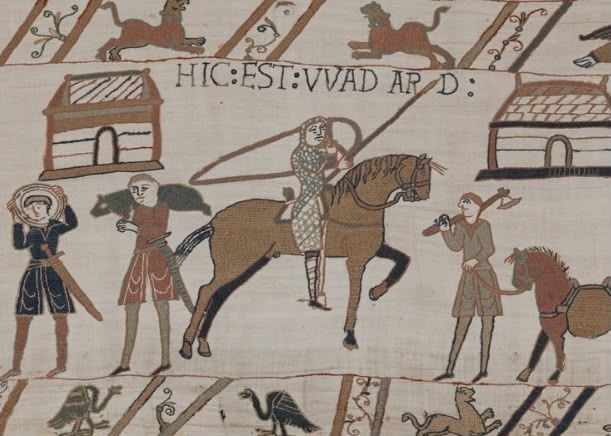
“But he was also a Dorset landlord, so we have reproduced this section of the famous tapestry, because it gives a portrait of the Domesday lord of Rampisham Manor in Dorset.”
According to the Open Domesday website, created by Anna Powell-Smith, Rampisham was a settlement in the Domesday Book, in the hundred of Tollerford. It had a population of 17 households in 1086.
The SDNQ went on to note: “Witness the following: The Bishop of Bayeaux holds RAMESHAM, and WADARD holds it of him. Lewin held it in the time of King Edward. It was taxed for six hides… Wadard hitherto held with this manor three virgates of land which the five thanes held in King Edward’s time and they were free to turn themselves over to the service of whom they would.”
SDNQ is a journal dedicated to the history of Somerset and Dorset. Published in an unbroken sequence since 1888, the journal is the oldest continuously published periodical of its kind.
Richard Grosvenor Bartelot was Dorset Editor of the SDNQ for 15 years. Bartelot was ordained in 1891 and served as a curate at Whitchurch Canonicorum and later Corfe Castle.
He became vicar of Fordington St George, Dorchester, in 1906 and stayed for 30 years. When he died, his ashes were placed in a niche near the altar there.
- This article was sourced with kind permission from SDNQ.
- For an annual subscription of £8 you can receive two copies a year of the SDNQ journal.