
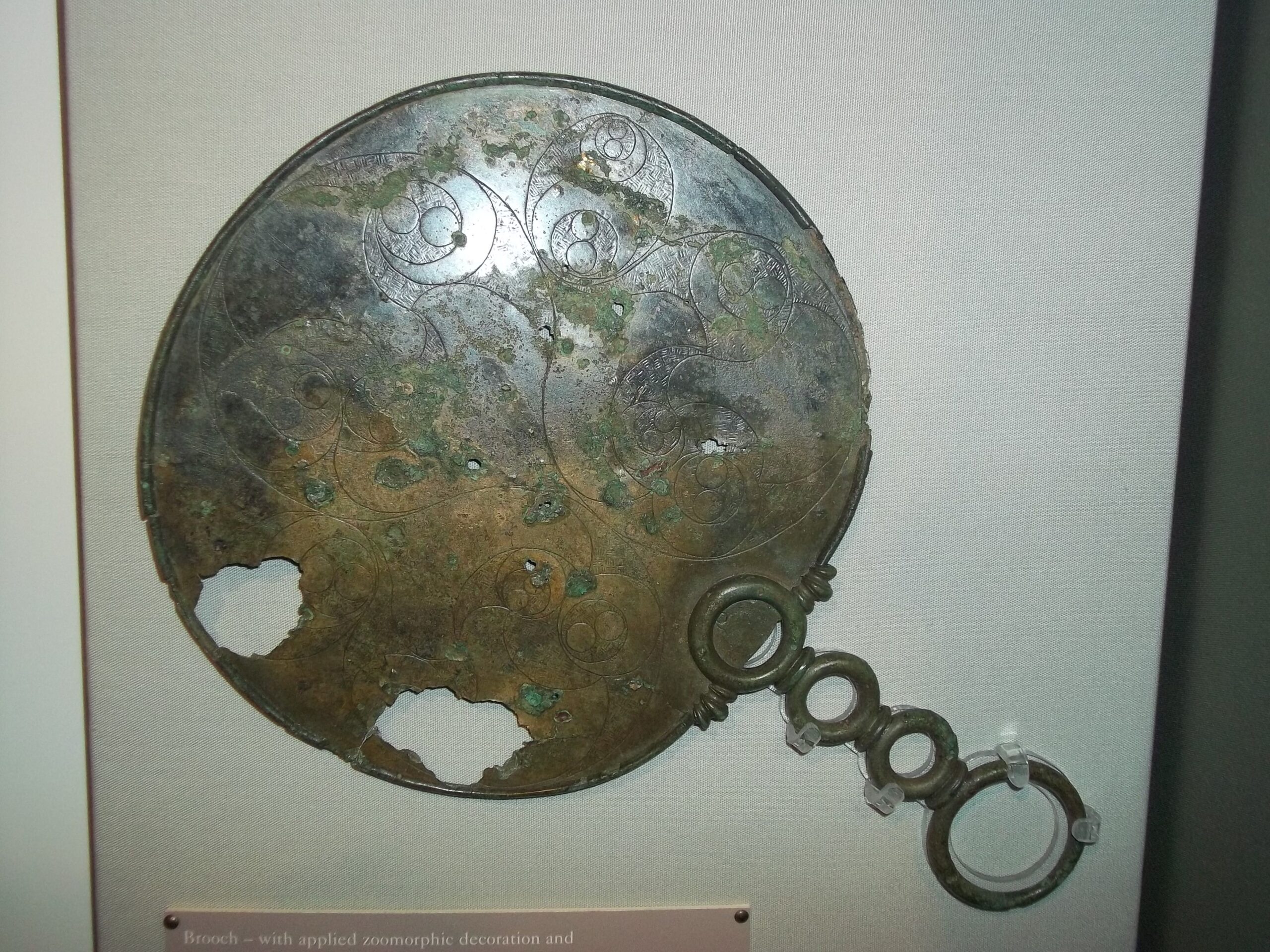
In 1994, a metal detectorist in Portesham discovered a decorated bronze mirror.
The find was reported to Weymouth Museum, and Wessex Archaeology was called in to excavate the disturbed burial.
Today you can gaze at the Portesham Mirror in Dorset Museum & Art Gallery in Dorchester. Curator of Archaeology Jon Marrow explains why it still captivates.
“It’s one of my favourite objects,” says Jon. “It’s very late Iron Age, one of the very last objects from our period of prehistory.”
“It’s mysterious because there aren’t good records about it,” he adds. “I think it’s an innately intriguing object.”
The mirror is in remarkably good condition, but it would never have given the crisp reflection we take for granted today.
Made of polished bronze, it would have shone a coppery colour, and the face looking back would have been dim and shadowy.
That raises the possibility that it was something more than a practical object.
“We call it a mirror, but actually it captures this idea that maybe, as far as late Iron Age people were concerned, this had special powers.”
The former Children’s Laureate Michael Rosen wrote a poem inspired by the mirror, as part of the University of Manchester’s Grave Goods project, which explores objects buried with the dead in prehistoric Britain.
The back of the mirror carries a flowing, swirling design.
“It would have looked stunning when it was new and polished,” says Jon.
The woman buried with the Portesham Mirror
Because the mirror was buried with a person, scientists have been able to learn a little about her.
She was between about 26 and 45 when she died and had arthritis in her back.
Other objects in the grave included brooches, a toilet set and part of a Roman strainer. These suggest she was buried around the time of the Roman conquest of AD 43, a period of upheaval for the Durotriges, the people of this part of Dorset.
The quality of these goods marks her out as wealthy, at the upper end of her society.
Similar richly furnished burials of women have been found elsewhere in Dorset. Separately, DNA from an Iron Age cemetery at Winterborne Kingston, near Bere Regis, suggests that when people married, the man moved to live in the woman’s community. That raises an intriguing question: were power, inheritance and leadership passed down the female line?